You know the feeling. You see another dog owner approaching from a block away, and your heart rate starts to climb. You tighten your grip on the leash, wrap it around your hand twice, and start scanning for an escape route—an alleyway, a parked car, anything to hide behind. Before you can move, your dog has already spotted the 'intruder.' The barking begins, followed by lunging and spinning. You feel the judgmental stares of neighbors as you struggle to move your pet along. If this sounds like your daily life, you aren’t alone, and more importantly, your dog isn’t 'bad.'
Reactivity is one of the most common challenges pet parents face, yet it is also one of the most misunderstood. It isn’t necessarily about aggression; often, it’s about big emotions—fear, frustration, or over-excitement—that your dog doesn’t know how to handle. Learning the nuances of why does my dog bark so much? is the first step in realizing that your dog is having a hard time, not giving you a hard time. In this guide, we will explore a compassionate, science-backed approach to reclaiming your walks and building a deeper bond with your dog.
Understanding the Root of Reactivity
Reactivity is essentially an overreaction to a normal stimulus. While most dogs might look at a passing bicycle or another puppy and keep walking, a reactive dog loses their ability to process information. Their 'thinking brain' shuts down, and their 'survival brain' takes over. This is often caused by a lack of socialization, a past traumatic event, or simply a genetic predisposition to being hyper-alert.
🐶 Unlock Your Dog's Hidden Intelligence!
Transform your dog's behavior with **Brain Training for Dogs** – a proven, science-based training system that enhances your dog's intelligence and obedience.
🐾 Get Started Today →When we look at how to train a rescue dog, we often see that reactivity stems from a need for safety. If a dog feels they cannot escape a situation (because they are on a leash), they use loud behaviors to create distance. By barking and lunging, they are effectively saying, 'Stay away! You're making me uncomfortable!' Understanding this shift in perspective is vital for a stress-free training journey.
The Power of the Threshold
The 'threshold' is the most important concept in reactive dog training. It is the invisible line where your dog can see a trigger but remains calm enough to take a treat or listen to a command. If your dog is already barking, they are 'over threshold.' At this point, no learning is happening. Your only job is to move away calmly.
To make progress, you must work 'sub-threshold.' This means finding the distance at which your dog notices the trigger but doesn't react. For some dogs, this might be 50 feet; for others, it might be the length of a football field. Managing this distance is much easier when you have mastered how to stop your dog from pulling on the leash, as it gives you better physical control while you focus on the mental aspect of training.
Why Mental Stimulation is the Secret Ingredient
Most owners of reactive dogs focus solely on physical exercise, thinking a tired dog is a calm dog. However, for a reactive dog, high-intensity physical exercise can actually spike cortisol levels, making them more jumpy. The real key to a calmer dog lies in their brain. When a dog’s mind is engaged, they are less likely to obsess over external triggers.
Using a program like Brain Training for Dogs can be a lifesaver for reactive households. By teaching your dog to solve puzzles and focus on you despite distractions, you are building the 'concentration muscles' they need on walks. If you notice 5 signs your dog needs more mental stimulation, such as pacing or indoor barking, it's a clear indicator that their reactivity might be fueled by pent-up mental energy.
Step-by-Step Exercises for Peaceful Walks
1. The 'Look at That' (LAT) Game
This is a classic positive reinforcement technique. When your dog looks at a trigger (like another dog) from a safe distance, you mark the behavior with a click or a 'yes!' and give them a high-value treat. Eventually, your dog will look at the other dog and then immediately look at you for their treat. You are literally changing their emotional response from 'Oh no, a dog!' to 'Oh boy, a dog means a snack!'
2. The Emergency U-Turn
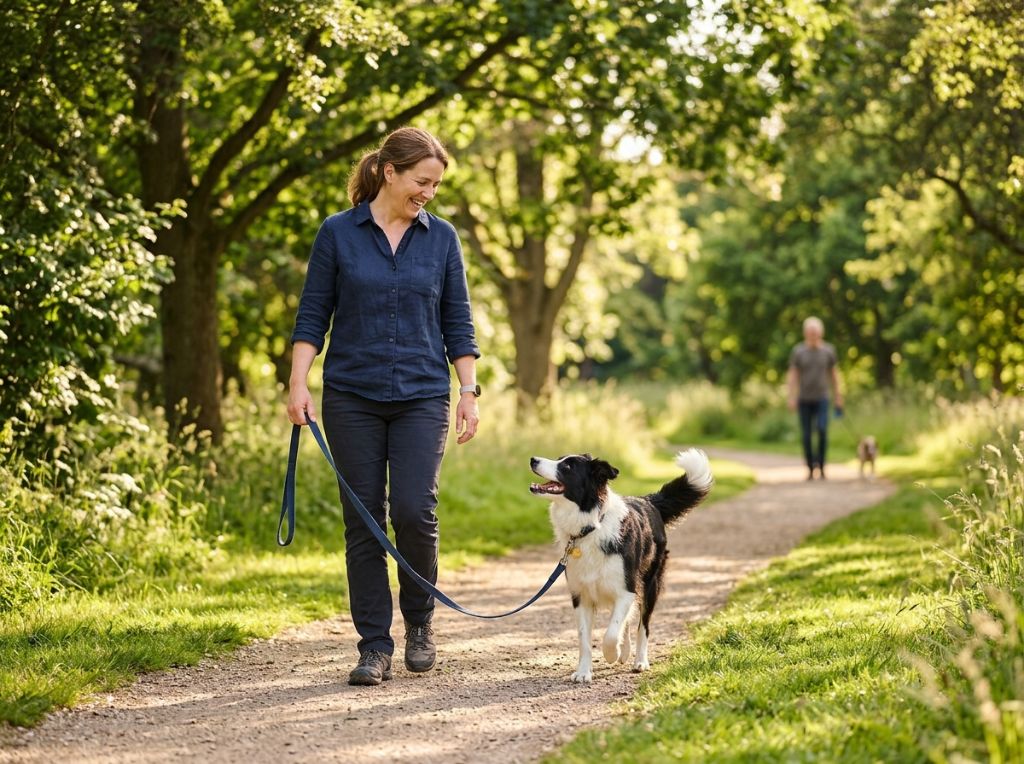
Sometimes, a trigger appears out of nowhere. Instead of panicking, practice a cheerful 180-degree turn at home. Make it a fun game so that when you need to do it on the street, your dog follows your lead happily rather than feeling like they are being dragged away in fear.
3. Scent Work on the Go
Allowing your dog to sniff is one of the fastest ways to lower their heart rate. If you see a trigger in the distance and your dog is still calm, scatter a few treats in the grass. This encourages 'foraging' behavior, which is naturally incompatible with lunging. It's a simple version of nose work for dogs that can be used as a management tool in the real world.
Building Confidence from the Inside Out
A reactive dog is often an insecure dog. They feel they need to handle threats themselves because they don't fully trust the environment or their handler's ability to keep them safe. This is why you should focus on activities that boost your dog’s confidence at home. When a dog feels capable and successful in training games, that confidence eventually bleeds over into their outdoor life.
Remember, consistency is more important than duration. Five minutes of focused 'threshold work' is better than an hour-long walk where your dog is constantly stressed. According to the American Kennel Club, positive reinforcement is the most effective way to manage behavior because it addresses the underlying emotion rather than just suppressing the symptoms.
Managing Your Own Stress
Your dog is a sponge for your emotions. If you are tense, they assume there is something to be worried about. Take deep breaths. If a walk goes poorly, don't beat yourself up. Training a reactive dog is not a straight line; it's a series of two steps forward and one step back. If you find yourself overwhelmed, it might be helpful to look into why you don’t need to pay $350/hour for a certified dog trainer when there are excellent, affordable digital resources available to guide you.
Frequently Asked Questions
Can reactivity be cured?
While some dogs may always be slightly more sensitive, most reactivity can be significantly managed to the point where walks are enjoyable again. The goal is 'functional' behavior, where the dog can recover quickly from a trigger.
Should I use a muzzle?
Muzzles can be a fantastic safety tool that gives owners peace of mind. A dog wearing a muzzle isn't necessarily dangerous; often, they have a responsible owner who wants to ensure everyone stays safe during the training process.
How long does training take?
Behavior modification is a marathon, not a sprint. You should start to see small improvements in 2-4 weeks of consistent work, but complete transformation can take several months or longer depending on the dog's history.
🐕 Transform Your Dog’s Life Today!
Imagine a world where your dog listens, learns quickly, and behaves perfectly! With **Brain Training for Dogs**, you’ll experience a joyful, well-trained pet in no time!
🌟 Begin the Transformation →My dog is fine off-leash but reactive on-leash. Why?
This is very common! It’s called 'leash frustration.' When a dog is on a leash, they know they can’t use their natural 'flight' instinct, so they default to 'fight' (barking/lunging) to keep the scary thing away.
Conclusion: The Path Forward
Training the reactive dog is a journey of patience, empathy, and small victories. Every time your dog looks at a trigger and chooses to look back at you instead, celebrate it. Those small moments are the building blocks of a peaceful life together. By combining threshold management, positive reinforcement, and a robust mental stimulation plan like Brain Training for Dogs, you aren't just stopping a bark—you are giving your dog the gift of a calmer, happier world. Keep your chin up, keep your treats handy, and remember that you and your pup are a team. Better walks are just around the corner.
🐾 Say Goodbye to Bad Behavior!
Tired of your dog's stubborn habits? Discover a **fun and easy** brain training system that turns any dog into a well-behaved genius in just a few weeks!
🐶 Start Training Now →